5 Common Mistakes Beginners Make in Ballroom Dancing – And How to Avoid Them
Stepping onto the dance floor for the first time is a unique blend of exhilaration and terror.
There is the romantic allure of gliding across the floor in a waltz, or the fiery energy of a salsa, contrasted sharply by the fear of stepping on your partner’s toes – literally and figuratively.
If you are new to this world, take a deep breath. Every dancer you admire, from the instructors at your local studio to the professionals on Dancing with the Stars, started exactly where you are right now. They all felt awkward, they all missed steps, and they all had to learn the hard way.

However, you have an advantage.
By identifying the most common pitfalls early, you can fast-track your learning curve. Whether you are looking to compete or just want to survive a wedding reception, avoiding these five common mistakes will improve your balance, your connection, and your enjoyment of the dance.
Mistake #1. The “Shoegaze”
It is the most universal instinct in beginner dancing. You are learning a box step or a cha-cha basic, and your brain is frantically signalling your feet where to go. To ensure they obey, you look down.
While this provides a temporary sense of security, staring at your feet is detrimental to your dancing for several reasons.
First, the human head weighs between 10 and 12 pounds. When you tilt that weight forward to look at the floor, you disrupt your spinal alignment. This throws your center of gravity forward, making you feel heavy to your partner and making turns significantly harder to execute.
Second, ballroom dancing is about connection. If you are looking at your shoes, you are breaking the visual and energetic connection with your partner. You are essentially dancing alone in a room full of people.
*********** What do you think about this version?*********
When you’re just starting out with dancing, it’s totally natural to feel a bit overwhelmed. Imagine you’re trying to master a box step or the basic cha-cha, and your brain is sending frantic signals to your feet about what to do next. In this moment, you might find yourself glancing down at your feet, thinking it’ll help you keep everything in check.
But here’s the thing: while that glance might give you a temporary sense of security, looking down can actually hinder your progress more than you might realize.
For one, did you know that your head weighs between 10 and 12 pounds? When you lean forward to peek at the floor, it messes with your spinal alignment. This can throw your center of gravity off balance, making you feel heavy to your dance partner and making those fancy turns much trickier to execute.
More importantly, ballroom dancing is all about connection! If you’re staring at your shoes, you’re losing that vital visual and energetic connection with your partner. It’s like dancing solo in a crowded room, and let’s be honest – that’s not the point.
And here’s the part most beginners don’t realize:
Your body learns faster through your inner eye.
When you imagine the movement—seeing it in your mind instead of checking it with your eyes—you train deeper body awareness. This internal visualization builds self-control, balance, and coordination faster and more permanently than watching your feet ever could.
Lift your gaze. Trust your inner eye. Your body learns best from the inside out.
How to Avoid It
Trust your proprioception. Proprioception is your body’s ability to sense its location in space without visual aid.
Think about driving a car. You don’t look at your feet to find the brake pedal. You trust your muscle memory.
- The Fix: Pick a focal point at eye level. If you are the Lead, look over the Follow’s right shoulder. If you are the Follow, look over the Lead’s right shoulder (or follow the specific styling for the dance).
- The Drill: Practice your basic steps at home in front of a mirror, but cover the bottom half of the mirror with a sheet or towel. Force yourself to look at your own eyes while your feet do the work.
*********** What do you think about this version?*********
How to Avoid “Shoegaze” in Social Dancing — and Fix It
- Use Your Inner Eye, Not Your Physical Eyes
Did you know that your body learns faster through internal awareness? Before taking a step, visualize the movement in your mind. Picture the direction, rhythm, and shape of the dance. This mental imagery enhances your control, balance, and coordination more effectively than
constantly checking your feet. If you can imagine the movement clearly, your body can execute it effortlessly!
- Pick a Soft Visual Focus
Instead of fixating on your partner or the floor, choose a soft focus point at eye level, slightly above the horizon. This technique keeps your head aligned, your spine tall, and your center balanced while allowing you to maintain peripheral awareness of your partner. Think presence, not staring! This helps you feel connected and engaged in the dance, making your experience more enjoyable.
- Trust the Floor Patterns
One of the exciting aspects of social dancing is that most ballroom steps follow predictable floor patterns. Once you learn these patterns, your feet can move confidently on autopilot. If you keep your gaze upwards, you’ll learn faster and more effectively. Stay upright, stay engaged, and watch how quickly your dancing improves!
- Slow the Music Down
Feeling anxious? Many novices experience what’s known as “shoegaze,” but it often stems from panic rather than a lack of ability. Practicing at a slower tempo allows your brain to process timing and direction without rushing into survival mode. Remember, slow practice leads to faster improvement. Embrace the rhythm at your own pace!
- Practice Without a Partner (Briefly)
Running the dance step on your own for a moment can boost your confidence. Focus on maintaining good posture and balance before returning to your dance partner. This builds your skills without sacrificing the connection essential to social dancing. It’s all about progress, not perfection!
- Let the Mistake Happen
Remember, looking down is often a way to try to control the situation. But embracing slight imperfections is a vital part of dancing. Allowing a mistake to happen builds your nervous system’s resilience and adaptability—skills crucial to real social dancing. It’s not perfect feet that make great dancers, but rather the presence and joy they bring to the dance floor.
****************************************************************************************************** Mistake #2. Leading and Following with the Arms
One of the most difficult concepts for beginners to grasp is the “frame.” Beginners often believe that “leading” means pushing the partner’s arm in the direction they should go, and “following” means waiting for a tug on the arm to move.
This results in “spaghetti arms” (too loose) or “rigid arms” (too stiff). If a Lead tries to move a Follow using only arm strength, it feels jerky and uncomfortable. It breaks the fluidity of the dance and can actually cause shoulder pain.
In reality, the arms are just the frame; the body does the leading and following. How to Avoid It
Connect your frame to your core. Imagine you are pushing a heavy shopping cart. You don’t push the handle away from you with your arms – you lock your arms in a comfortable position and use your legs and core to move the cart forward. The cart moves because you move.
- The Fix: Establish a strong frame where the elbows are slightly in front of the body, not pulled back behind the shoulders. Engage your muscles down the side of your back to support your arms without tension.
*********** What do you think about this version?*********
Many dance beginners misinterpret the leading role as just pushing their partner, while following is seen as passively waiting. This can lead to awkward movements, often referred to as
“spaghetti arms.” However, understanding the fundamentals of lead and follow turns dancing into a joyful conversation through movement.
The Role of the Leader and Follower
In social ballroom dancing, the leader’s role is to invite movement using their arms and body, providing gentle signals for direction and timing. Meanwhile, the follower actively engages with this invitation, maintaining balance and responsiveness. This is where the magic happens: both dance partners are responsible for their own movements, creating a fluid and enjoyable dance experience.
When leaders clearly invite movements, it enhances the overall flow of the dance and prevents surprise reactions from the follower. A clear invitation allows for natural responses, fostering a cooperative, rather than forced, dynamic on the dance floor.
Building a Strong Connection
One of the keys to successful social ballroom dancing is feeling connected with your partner. Think of your arms as instruments of invitation while your body executes the movements. The arms should create a supportive frame that encourages freedom of movement rather than pushing or pulling. Establishing a comfortable connection is crucial; it’s akin to steering a shopping cart using your legs and core for support.
***********************************
Mistake #3. The “Giant Step”
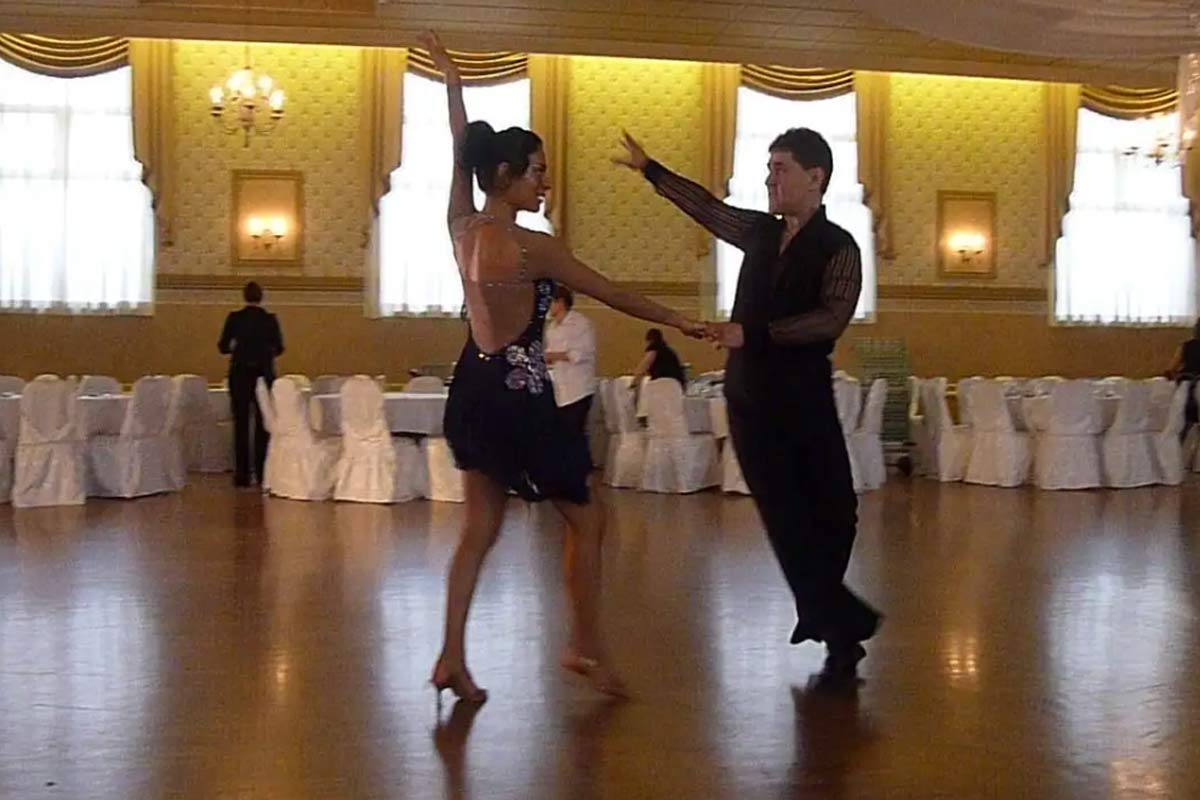
When beginners watch professionals dance, they see sweeping movement and dynamic travel across the floor. In an attempt to replicate this, beginners often take massive steps.
The logic seems sound: To move across the floor, I must take big steps.
However, in ballroom dancing, big steps usually lead to a loss of balance. When you step too far, your feet move faster than your body’s center of gravity. You end up “split” (legs wide apart), which makes it nearly impossible to change direction or turn quickly.
Furthermore, if you are taking our ballroom dance classes in Toronto or North York, you will likely be learning on a floor with other couples. Taking massive, uncontrolled steps is a surefire way to collide with other dancers.
How to Avoid It
Move your center, then your feet. Great movement comes from pushing off the standing leg, not reaching with the moving leg.
- The Fix: Focus on keeping your feet “under” your body. Your step size should only be as large as your balance allows. In smooth dances like the Waltz, the power comes from the lowering and bending of the knees, which propel the body forward. The foot just lands where the body arrives.
- The Drill: Practice walking naturally. Notice how your body weight shifts forward before your foot leaves the ground? Apply that to your dance. Keep your knees soft. If you feel like you are “falling” into your step, you are likely over-striding. Shorten your stride and focus on the push-off.
*********** What do you think about this version?*********
Mistake #3. The “Giant Step”
When beginners watch professionals dance, they see sweeping movement and dynamic travel across the floor. In an attempt to replicate this, beginners often take massive steps.
The logic seems sound: To move across the floor, I must take big steps.
However, in ballroom dancing, large steps often result in a loss of balance. When you step too far, your feet move faster than your body’s center of gravity. You end up “split” (legs wide apart), which makes it nearly impossible to change direction or turn quickly.
Furthermore, if you are taking our Social ballroom dance classes in Toronto or North York, you will likely be learning on a floor with other couples. Taking massive, uncontrolled steps is a surefire way to collide with other dancers.
How to Avoid It.
Move your center, then your feet. Great movement comes from pushing off the standing leg rather than reaching with the moving leg.
The Fix: Focus on keeping your feet “under” your body. Your step size should be no larger than your balance allows. In smooth dances like the Waltz, the power comes from the lowering and bending of the knees, which propel the body forward. The foot lands where the body arrives.
The Drill: Practice walking naturally. Notice how your body weight shifts forward before your foot leaves the ground? Apply that to your dance. Keep your knees soft. If you feel like you are “falling” into your step, you are likely over-striding. Shorten your stride and focus on the push-off.
*********************************************************
Mistake #4. Ignoring the Rhythm
Music is not just background noise in ballroom dancing – it is the boss.
A common mistake, particularly in energetic dances like Jive or Salsa, is rushing. The adrenaline kicks in, and suddenly you are dancing three times faster than the song.
Conversely, some students become so obsessed with the mechanics of the step (Left foot here, Right foot there) that they completely ignore the beat. They are dancing through the music rather than to the music.
For example, if you decide to take salsa dance classes, you will quickly learn that the “Quick-Quick-Slow” rhythm is the heartbeat of the dance. If you ignore the “Slow” (the pause or hold), the dance falls apart.
How to Avoid It
Listen before you move. You cannot dance to music you aren’t hearing.
- The Fix: Start listening to ballroom and Latin music in your spare time – in the car, while cooking, or at the gym. Don’t try to dance – just try to identify the beat. Count “1-2-3-4” or “1-2-3” depending on the song style.
- The Strategy: If you get lost during a dance, stop. Don’t just keep shuffling, hoping to find the beat by accident. Pause, listen for the “One” (the heavy downbeat), and restart. Your partner will appreciate the reset much more than a chaotic struggle to catch up.
*********** What do you think about this version?*********
Mistake #4. Ignoring the Rhythm / dancing of beat
Music in ballroom dancing is not just background noise — it is the foundation. The beat creates a shared ground for both partners, giving structure, timing, and unity to the dance. Without it, even correct steps lose their meaning.
A common mistake in social dancing, particularly in energetic dances such as Swing or Salsa, is rushing. The adrenaline surges, excitement builds, and the dancer accelerates without noticing.
On the opposite end, some dancers become so focused on the mechanics of the dance — left foot here, right foot there — that they slow down and fall behind, like in the Waltz.
In both cases, the dancer moves through the music rather than with it.
Take Salsa as an example. If you decide to take salsa dance classes, you quickly learn that the “quick–quick–slow” rhythm is the heartbeat of the dance. The slow is not empty time — it is a pause, a hold, a moment of control. When that “slow” is ignored, the structure collapses, and the dance begins to feel rushed and disconnected.
Fixing the problem:
The first step to fixing this problem is learning to listen before you move. You cannot dance to music you are not truly hearing. One simple way to find the rhythm is to imagine yourself at a concert, clapping along with the crowd. You’re not analyzing — you’re just feeling the pace of the melody. Once the basic pulse feels comfortable, begin to notice the stronger, accented beat.
This accented beat is essential for synchronizing your steps with the rhythmic pattern and, just as importantly, with your dance partner.
For example, in Waltz music, the rhythm follows a strong–weak–weak pattern, counted as one–two–three. The “one” is the heavy, accented beat, while “two” and “three” are lighter. When your movement aligns with that strong beat, the dance immediately feels more grounded, smooth, and musical.
A powerful habit is to listen to ballroom and Latin music in your spare time — in the car, while cooking, or at the gym. There is no need to dance. Simply try to identify the beat and count it: “one–two–three–four” or “one–two–three,” depending on the style. This trains your “dance ear” and makes rhythm recognition automatic.
And if you ever get lost during a dance, the best strategy is to stop. Don’t keep shuffling and hoping to accidentally land back on time. Pause, listen for the “one” — the heavy downbeat — and restart. Your partner will appreciate a calm, confident reset far more than a chaotic attempt to catch up.
*********************************************************
Mistake #5. The Comparison Trap: Expecting Perfection Immediately
This is perhaps the most dangerous mistake because it leads to quitting.
Beginners often look at other couples in the studio – perhaps a couple who has been dancing for five years – and feel discouraged. They think, “I look clumsy,” or “I’ll never move like that.”
Ballroom dancing is a complex skill. It requires the coordination of a high-level athlete, the musicality of a musician, and the artistic expression of an actor. You are learning a new language with your body. You would not expect to speak fluent French after three lessons. Do not expect to dance a perfect Foxtrot after three weeks.
How to Avoid It
Focus on your own journey. Every dancer has a different background. Some have previous experience in ballet or athletics; others are starting from scratch.
- The Fix: Set small, achievable goals. Instead of “I want to look like a pro,” aim for “I want to keep my head up for this entire song” or “I want to finish this Salsa turn without losing my balance.”
Putting It All Together
To recap, here is your checklist for your next practice session:
- Chin Up. Look at your partner or the room, not your feet.
- Frame Check. Lead and follow with your body/core, not your arm muscles. ● Step Small. Keep your feet under your body and push from the floor. ● Count the Beat. Let the music dictate your speed.
- Be Kind to Yourself. Celebrate small victories.
Avoiding these five mistakes will not only make you a better dancer technically, but it will also make the experience far more enjoyable for you and your partner. Dancing is, ultimately, an expression of joy. Don’t let the mechanics steal that joy from you.
The best way to fix these mistakes – or avoid them entirely – is with professional guidance. You don’t have to figure this out alone.
Dancingland Dance Studio is dedicated to making your introduction to dance smooth, fun, and exciting. We specialize in working with beginners, helping you build confidence from your very first step.
We invite you to experience the difference personalized instruction makes. Call us today at 416-358-5595
Stop watching from the sidelines. Call Dancingland Dance Studio and start dancing today!